Monday, September 12, 2011


Thursday, September 1, 2011
mobile lawsuits
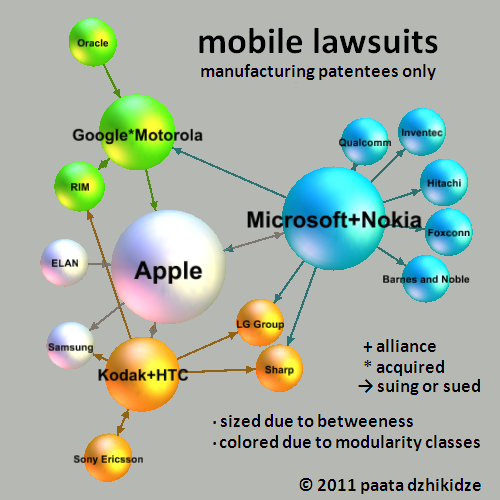
- The center of mobile lawsuits graph is Apple only. The leader.
- All other key players are dual as Google*Motorola (acquired), Microsoft+Nokia (alliance) and Kodak+HTC (virtual alliance). Weighty only in couple.
Design. Who is out, who are combined.
There are not non-manufacturing patentees in the graph. Just because non-manufacturing patentees are not in mobile segment but in mobile lawsuits segment. An ideal business without consumers but with rights.
Consolidated players are:
- Google*Motorola by acquisition;
- Microsoft+Nokia by alliance,
- Kodak+HTC by alliance on the totality of signs as no suits between them and there is a cooperative product (HTC Desire S Kodak Gray).
The segment has not more such alliances.
Primary data is here.
Thursday, August 18, 2011
analysis of the social graph. personal.
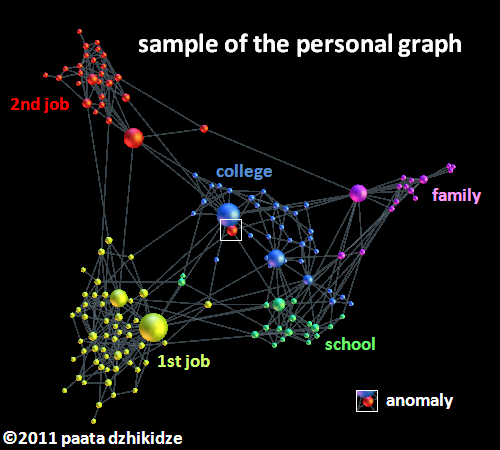
Arthur Rock: “People, people, people.” People are around you. Those, with whom you study (studied), work (worked), have (had) a good time, live (lived). Some of them are familiar with each other. Someone has fewer friends in common with you, someone has more.
Strong ties
See the seal connections where there is a group of people with whom you do (did) something together. Each group has its own social activist. Such person links the group inside.
There are people who are not in only one of your groups, but they are in two or more groups. These people link different groups together.Often your familiar connects two of your group due to natural causes, such as:
- studied together at school, and then further;
- studied together, and then worked in the same company;
- moved together from one company to another;
- work(ed) in one company with a relative.If your friend joins three or more of your communities, you have a lot in common. Or this friend’s set of connections is a result of targeted efforts.Graph connectivity
Your groups can be not linked among themselves. If you are young. Or this is your profession. Or you didn’t display your connections, and this is your job.Socialization
If you have a friend with no friends in common, this connection is superficial. That is, it is a contact, but not socialization yet.
There is always the biggest simply-connected part of the graph. You live in this part. Either you have a transition period.Contacts and connections
A thousand of unconnected contacts is just spammer database. A thousand-contact network is your social capital.You need to achieve. You want to raise your capitalization in the labor market and/or in the market of corporate control. This is only possible when using your social capital. You already have it surely, and now is the time to its revision.You can calculate persons through whom the wind of change is streaming. Or through which you can send the wind. Anyway, you need special attention to communicate with these people.Your personal graph has not only key persons but key links between them too. Current, prospective, concealed. Different. Warning
Social graph is a model of reality, but not reality itself.
Wednesday, August 3, 2011
business plans. start.
You want to have written a business plan and don't know where to start. Here is my structure of a business plan:
The main sections• Proposal (for external business plans)
• Profile & Industry
• Strategy & SWOT
• Product & Customers
• Markets & Regulation
• Sales & Competitors
• Manufacturing & Suppliers
• Management & Team
• Finance & CapitalAppendix
• Basic assumptions
• Detailed calculations
• Technical detailsThe left part of the dual titles is descriptions and numbers. The right part of the dual titles is actors, their interests and behavior.Process
• Only one person should have both responsibility and authority for writing a business plan.
• You need another person from outside the team for reading of releases. With a fresh head. From related industry or professional in business plans. Always pay written feedback.
• After the initial filling, you will get your own vision. You will correct the structure and rewrite the plan again. Typically three times, it is important to have stopped.Structure
There is no fixed structure. Most often it is determined by for whom you are writing a business plan.
Professional standards actually define:
• leading audit firms (Big4)
• leading consulting company (McKinsey etc.)
• leading marketplaces (NYSE, LSE, TSE etc.)
• the largest international organizations: the United Nations (UNIDO), the European Union (TACIS).Size
It is not limited. Write brief and to the case."I wrote the business plan. And it was a page and a half, and I had raised all the money before I even sent the plan out." Arthur RockResult
Upon reading the business plan, a competent amateur can understand right away:
• what it is,
• how it works,
• where the money is.
Moreover, in the process of writing a business plan you will learn a lot about your business, your market and your team."In preparing for battle I have always found that plans are useless, but planning is indispensable." Dwight David Eisenhower
Modern sound: Plans are nothing, planning is everything.
Monday, July 25, 2011
globalization is already there…

This time, size of circle is due to betweeness centrality of megacity. The center of the graph is brighter than periphery. Color is due to calculated modularity classes:
- Green: LON, LOS, IST, CAI, MOW, THR, KHI, BOM, DEL, CCU.
- Red: DAC, JKT, CAN, BJS, MNL, SHA, SEL, OSA, TYO, LAX.
- Yellow: MEX, NYC, SAO, RIO, PAR.
Calculated modularity classes are not exactly due to distribution neither by continents nor by oceans nor by decimal time zones. Globalization is already there at level of connections between megacities.
Decimal time zones and IATA codes, in the order of longitude:
- 0 LON London, UK
- 0 PAR Paris, France
- 0 LOS Lagos, Nigeria
- 1 IST Istanbul, Turkey
- 1 CAI Cairo, Egypt
- 1 MOW Moscow, Russia
- 1 THR Tehran, Iran
- 2 KHI Karachi, Pakistan
- 2 BOM Mumbai, India
- 2 DEL Delhi, India
- 2 CCU Kolkata, India
- 3 DAC Dhaka, Bangladesh
- 3 JKT Jakarta, Indonesia
- 3 CAN Guangzhou, China
- 3 BJS Beijing, China
- 3 MNL Manila, Philippines
- 3 SHA Shanghai, China
- 4 SEL Seoul, South Korea
- 4 OSA Osaka, Japan
- 4 TYO Tokyo, Japan
- 7 LAX Los Angeles, USA
- 7 MEX Mexico City, Mexico
- 8 NYC New York, USA
- 8 BUE Buenos Aires, Argentina
- 9 SAO Sao Paulo, Brazil
- 9 RIO Rio de Janeiro, Brazil
Monday, July 11, 2011
problem investors
You are creating a business and you’re seeking investments. Since getting investment for you is not ultimate aim, you need to know before the deal with the investor:
• Legality of origin of capital
• Names of people that are the final owners of capital
• Limits of power of the person that is negotiating you
If you can’t ask these questions then business is not for you.
If the responses don’t suit you then you have no business at this time.
If you can’t check the responses then the business will not yours.
• You can not limit the business relationship. You will not run your business. Most of the time will be spent not on business but on the family plot. If the elders do not agree among themselves, the responsibility is on you.
• There is a risk of forced receiving unhelpful staff that is other relatives. You can’t fire them, you can’t punish them, you can’t isolate them from activities, and you have to pay them.
• Investor can make decisions impulsively, on the basis of emotion.
• Combinations that are dangerous for the business: Relative which Functionary, Relative which Coercion Practitioner.
• Illusion: my nephews and children-in-law do not disappoint me in any case.
• Fear: have to be ashamed in front of the most senior family members.
• Swindle: no.
• Countermeasures: to ignore family relations.Heir
Origin of capital is non-recurrent income: inheritance, compensation, benefit, finding the treasure.
• Typically, no business experience. Has a surplus of free time. Daily asks how things are going. Can invest just because he (she) likes the product, no calculating how many people might like it too.
• Illusion: enough to invest money once and will clip coupons.
• Fear: to be deceived.
• Swindle: no.
• Countermeasures: to document regularity of querying and reporting, and have appointed person for performing a specified range of errands of the investor.Gambler
• Origin of capital is the regular winnings in gambling, betting and so on.
• Invests if there is not enough cash for a major purchase.
• Often not available on all channels.
• Typical share is 10-25%
• Risks: the persecution of the investor for tax evasion, a sudden need for urgent withdrawal of funds.
• If he (she) is in a hurry to take out money from the business, you can buy his (her) share at big discount. Or not you.
• Illusion: business is just thrift-box of money to play, easy to take them out at all necessary.
• Fear: no.
• Countermeasures: to give not more than a blocking share, and to use additional channels of communication and warning systems.Celebrity
(Only well-paid, people of creative professions, sports, etc.)
• May have the emotional swings.
• Typical share is 10%.
• Illusions: the existence of your business will increase his (her) revenues from its core business.
• Fear: troubles in your business have a negative impact on its core business.
• Swindle: no.
• Countermeasures: have appointed person for libations, celebrations and consolations on star’s demand. For example, alco-drug-star-sitter.Functionary
• Demonstrates well-being. Is horrified by loss of position. Believes current position and the accompanying privileges deserved reward. May be useful only while in the capacity. After losing position blocks every decision about spending, avoid making decisions on principle. Prevents his (her) exit from the business. Categorically does not want to pay for anything.
• Typical share is 9% if he (she) is a beneficiary. Bigger share when using the nominal beneficiary. Interprets his (her) share as insurance against loss of the position. Usually, you make the nominal contribution to statutory fund instead of such investor.
• Speech: Avoid the word "I". Ambiguously uses the word "we." "We're starting to work" means "you will start to work." "We can solve this issue" means "My boss would resolve the issue"
• Illusion: nobody knows.
• Fear: loss of the position, and to have made a bad bargain in the exit.
• Swindle:
Step 1. To make hints of his (her) enormous potential and take a prepayment for a solution.
Step 2. If the problem is not solved, can partially return the prepayment as an honest person. If the problem is solved by itself, then considers this job done, as an honest person.
• Countermeasures: publicity, collection of blackmail from legitimate sources.Coercion Practitioner
• Refers to the business as a single operation.
• Accepts forecast as a liability.
• Looking for vulnerabilities.
• Prefers to participate in the business, products which can consume directly (hotel, restaurant, car services, club, etc.)
• Believes that the key to get into the business.
• Language: A lot of asks again.
• Illusion: In every business there is the only cherished chip, if get it he (she) can replace you by his (her) person.
• Fear: you are or become a Trojan horse from a more powerful organization.
• Swindle (for a simple business):
Step 1. The investor gives 100% of money; investor’s share is 51-75%, yours one is 25-49%. You give a receipt to the investor at the rate of your share.
Step 2. You are half a step from income, but something goes wrong. Suddenly, the investor declares that you have failed, and it's time to fix the damages. You give your share for a pittance in partial repayment of your debt to the investor in the receipt.
Step 3. The remaining half-step to income is made by trusted person of the investor. Business works, but without you.
• Transit money will go through you business, you can not refuse.
• Countermeasures: None. Just exit the business. Alive, healthy and at large.Protege
• Not owner. To lose the owners’ capital is to have lost credibility and income, to earn a lot for the owners of capital is to earn for himself (herself) a bit. Differs from the functionary by share size and swindles.
• Most honest funds write on their sites that they do not buy the share below the majority.
• Illusions: no.
• Fear: You will agree with investor which has better lawyers.
• Typical share is 51-75%.
• Swindle:
Step 1. You still have the controlling interest. Formally independent investor makes the first round; the first part of money is paid, the second part is promised. The business draws money. Patents and prototypes are in the ownership of the business.
Step 2. The investor declares that he ran out of money, but he (she) can agree on the second round. If you bring second investor, he (she) blocks the deal. In the second round his (her) and your shares is proportionately reduced. The transaction took place, you lose the majority. You think that you have a controlling interest together with the first investor, but in fact, the first and the second have got control together.
Step 3. The second investor is the fund, generally. Investors appoint their CEO. Money is in business, but you can not dispose of them.
Step 4. Investors will not sell you their share; you sell them your share of the residual value.
Step 5. Investment is made; the business goes to planned capacity, but without you.
• Countermeasures: each new contract to take away before signing, for a detailed examination with an adviser and lawyer. Separately.Fairy tales and true story
Fairy tales often end with the entry into long-term contract and a brief mention of the simultaneous withdrawal of the parties of this contract and the business. What is between the entrance to the business and the exit from it is not included into a format of fairy tale. That is, while the investment makes then the fairy tale ends and life begins.What to do
You are on the right way, if each item is true:
- You can check out basic information about the investor,
- Investor projects exit of the business before entering into business
- Investor has the experience of decision-making as the owner,
- Investor invests in your business his (her) personal money too,
- You understand how investors make decisions
- You are happy with feedback on the investor from entrepreneurs, who deal and / or dealt with the investor,
- You can check out this feedback on the investor. Examples of background check on consistency will be on another occasion.